Comprehensive guide to hearing aids

By and
The basics
With 48 million Americans affected by hearing loss, advancements in hearing aid technology have helped many re-connect with their world. Modern day hearing aids are small, digital, and many are available over the counter (OTC) to make better hearing more accessible.
Hearing aids are small electronic devices worn in the ear that help people experiencing hearing loss live their lives to the fullest. Today's hearing aids are not the same bulky, unattractive devices you may remember from the past. Most hearing aids are now digital, discreet, and can be easily controlled by using advanced technology.
Through convenient features like Bluetooth and mobile apps, allowing one to control hearing aid settings directly, consumers have more control over their hearing needs. Now you can adjust your hearing devices in real time or have licensed hearing professionals adjust them remotely.
Since your hearing is unique, it’s important to get a hearing aid that fits your hearing profile. As hearing experts who’ve helped over 100,000 customers, we’re here to explain what you need to know about hearing aids, so you can decide whether they’re right for you.
How do hearing aids work?
So, how do today’s hearing aids with digital technology work? No matter how modern, hearing aids still have four basic components:
- a microphone
- a processor
- an amplifier
- a receiver/speaker
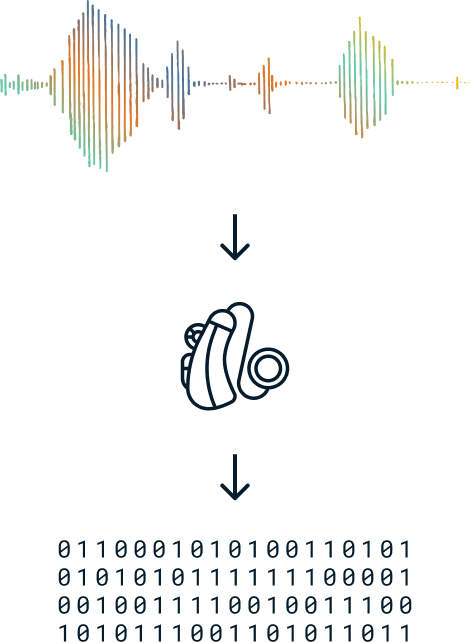
All components work together to analyze and amplify specific sounds so you can hear better. The microphone receives incoming sounds (sound waves). The sounds are then processed digitally and converted into electronic signals by the processor. These signals contain important information about the sounds, such as pitch, volume, and sound direction.
In more advanced models, the hearing aid’s chip and algorithms can help distinguish speech from unwanted noise. They can reduce the likelihood of feedback (a high-pitched squeal) and mitigate the discomfort of loud sounds. They can also adjust the way specific frequencies are amplified based on your unique hearing loss. These signals are then shaped and amplified, and delivered to your ear through the receiver/speaker.
Digital hearing aids work by converting the sound waves picked up by the device into numerical code.

Digital hearing aids work by converting the sound waves picked up by the device into numerical code.
Benefits of hearing aids
Hearing loss can impact so many aspects of your life, from your emotional well-being, to your relationships, work-life, and even your physical health. You might not realize the extent to which hearing aids will improve the quality of your life until you try them and see how many aspects of your life are touched and enriched by being able to hear the world around you.
There are numerous benefits to using a hearing aid appropriate for you. The biggest one, of course, is being able to hear others more clearly—and not continually asking them to repeat themselves! You'll also notice you hear the television and phone calls more clearly, enhancing your communication and engagement with friends, loved ones, and the rest of the world. Researchers are constantly working to understand the intricate relationship between hearing and the rest of our health.
Research suggests that treating your hearing loss with a hearing aid can lead to:
- Memory improvement
- Decreased risk of falls
- Decreased risk of hospitalization
- Mood improvement
- Decrease in anxiety and depression
- An increase in brain processing speed
- Reduction in risk of dementia
- Increased earning potential
In our opinion, an improvement in any one of the above would be well worth investing in your hearing.
Take our 3-minute online hearing test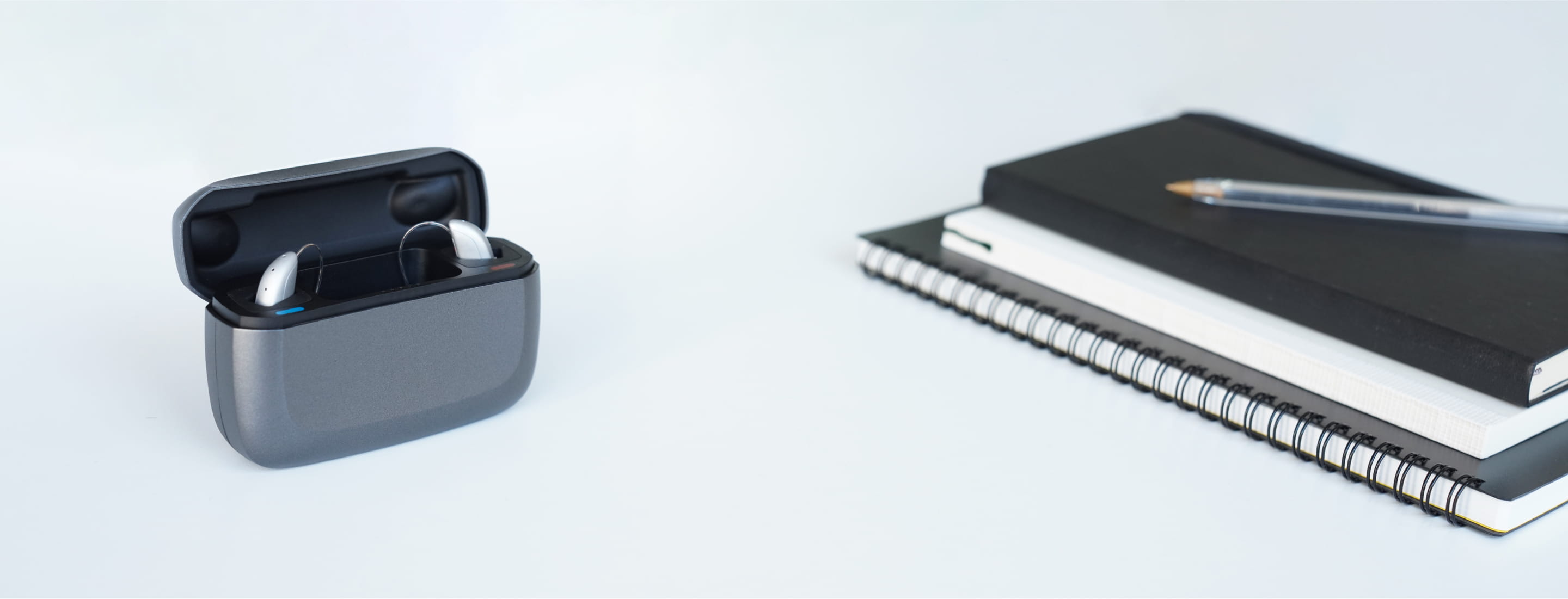
Choosing a hearing aid
Common types & styles
Hearing aids come in many different types and styles. You’ll need to consider which type of hearing aid will work best for you based on your hearing needs, lifestyle, and budget.
In-the-Ear vs. Behind-the-Ear: Which style is right for you?
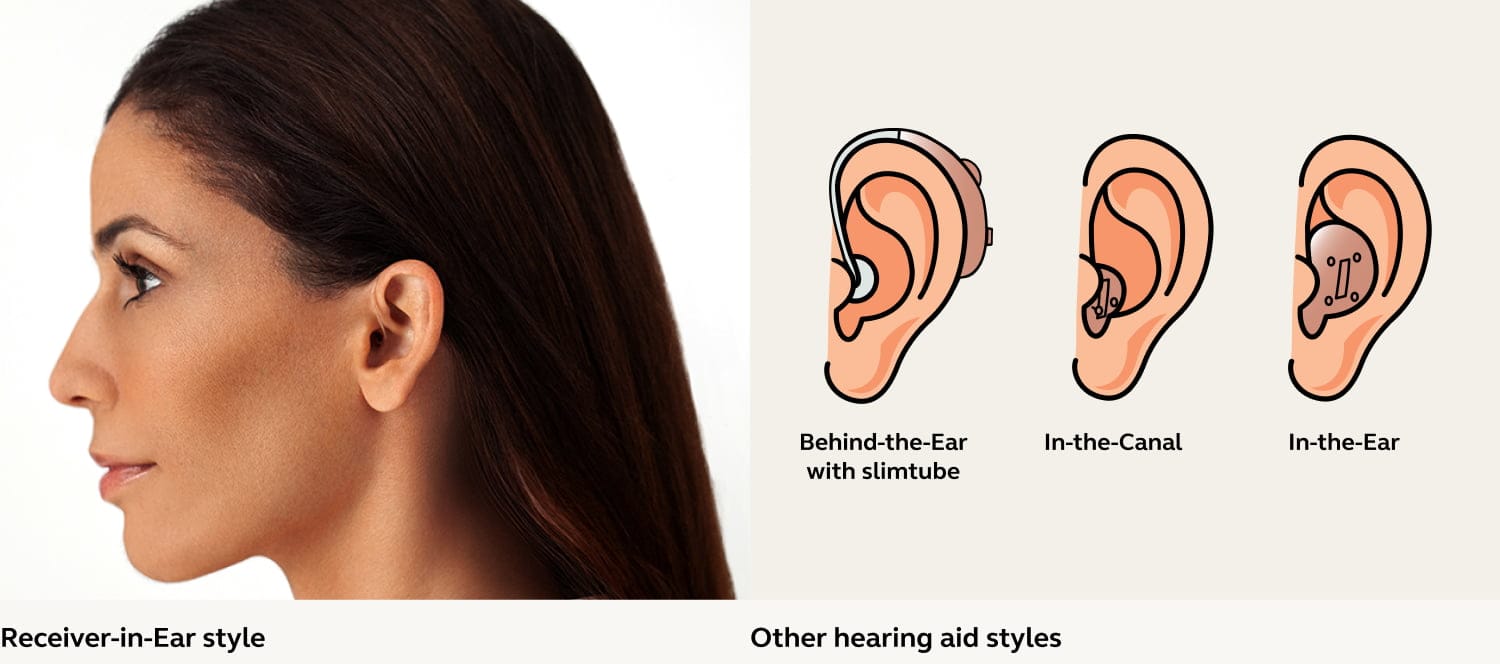
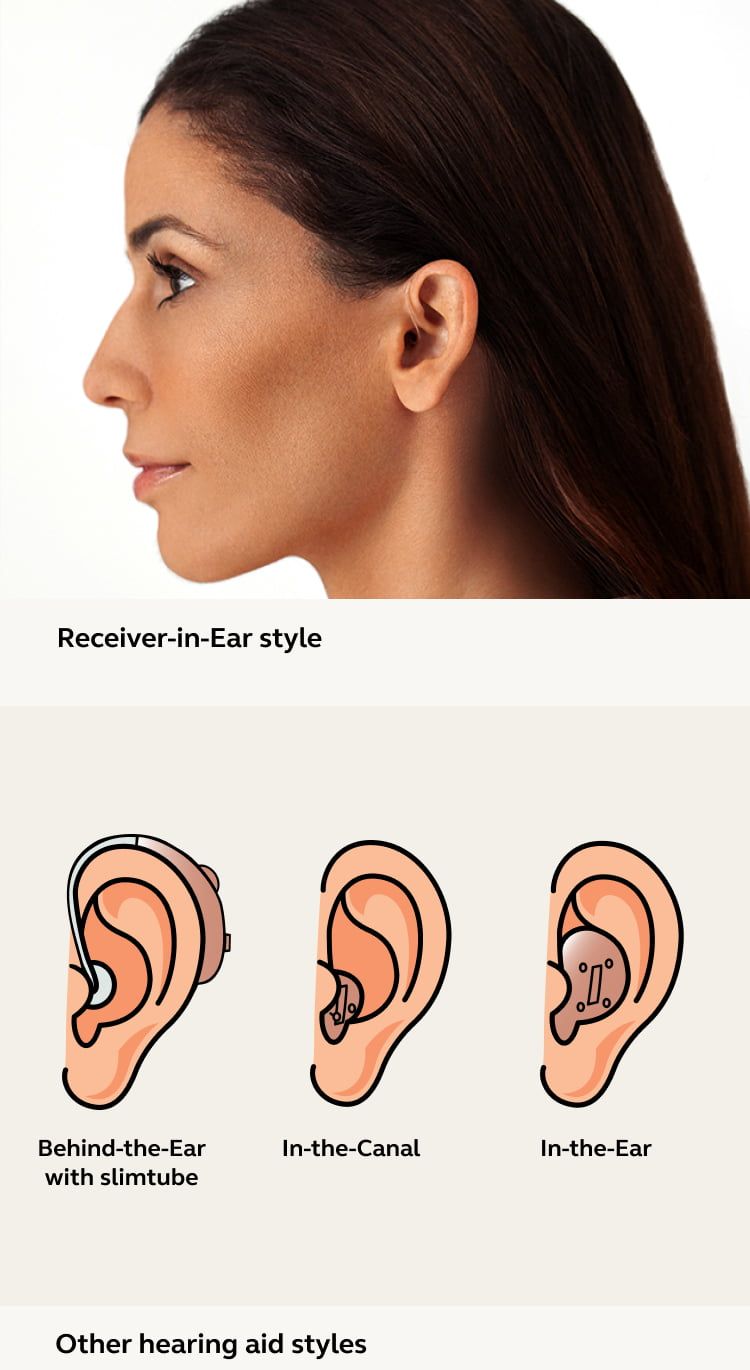
There are In-the-Ear (ITE) styles like Completely-in-Canal (CIC) and Invisible-in-Canal (IIC), where the hearing aid sits discreetly in the ear canal. With limited space, this tends to result in reduced battery life, connectivity features, and/or sound quality.
The most popular styles are Behind-the-Ear (BTE) styles. Out of these, the most common choice is Receiver-in-Ear (RIE) — where the receiver/speaker is placed in the ear canal and the processing component is placed behind the ear. Many RIEs offer powerful features, such as longer battery life and advanced noise reduction technology, while still packed in a small, discreet model.
Bluetooth-enabled hearing aids
Bluetooth-enabled hearing aids offer convenient features that allow wearers to adjust their hearing aid settings with their mobile device. Utilizing the Bluetooth enabled in the hearing aids allows them to be paired with devices such as an iPhone or Android smartphone.
Some Bluetooth-enabled hearing aids, like our Enhance Select hearing aids, also allow customers with compatible devices to stream phone calls or their favorite music or television shows directly to their hearing aids.
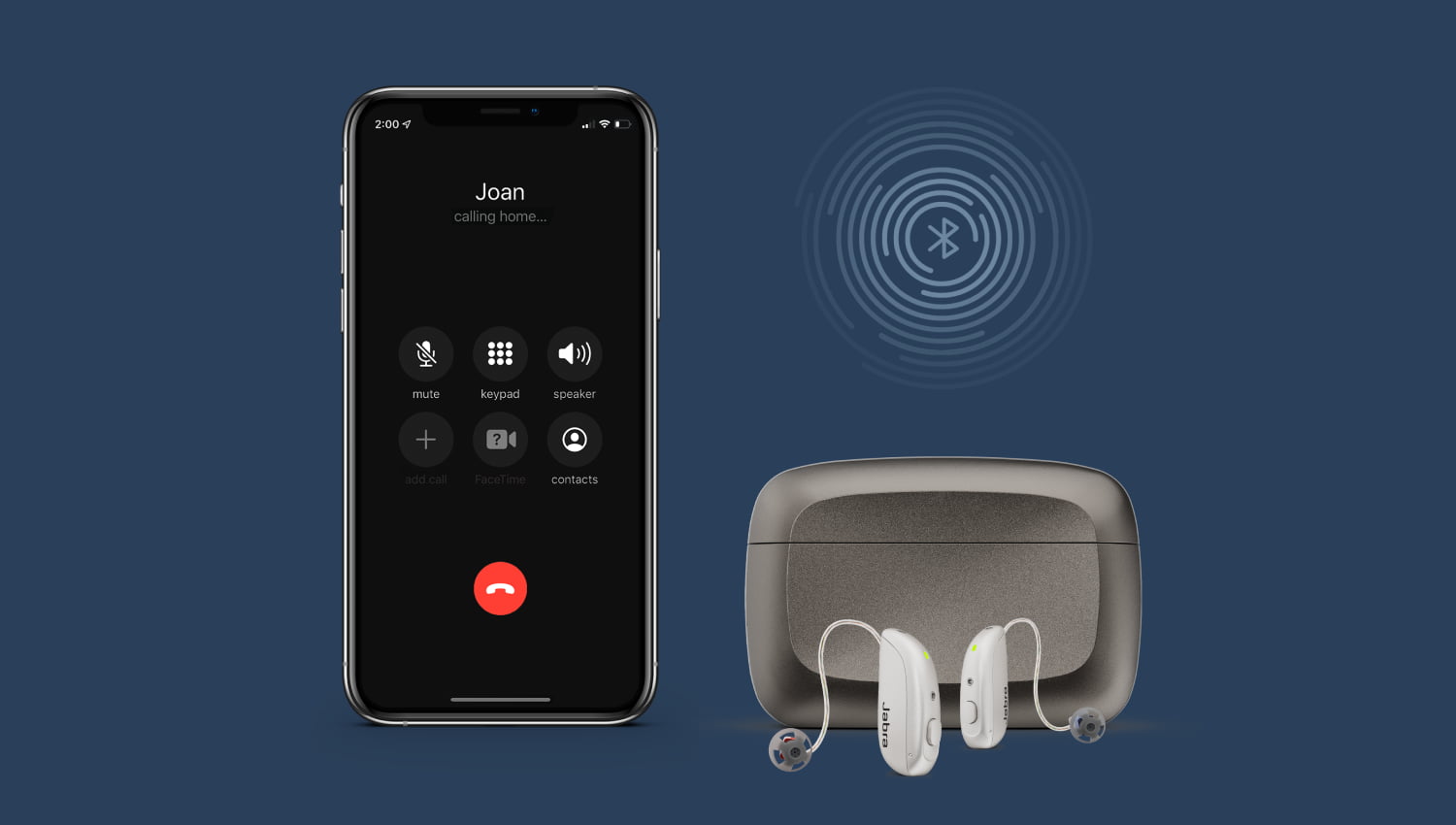
Enhance Select hearing aids connect to your phone with Bluetooth, allowing you to adjust the settings through an app.
Connecting with audiology services
Bluetooth also allows customers to adjust their hearing aid settings using their smartphone or other smart devices, often through an app. For example, if you are in a crowded restaurant, you can use the Jabra Enhance Select app to instantly change the setting on your hearing aids to reduce background noise and focus on speech.
The same connectivity also makes it possible for Jabra Enhance hearing aids to be adjusted virtually by licensed professionals on our Audiology Team. The convenience of telehealth allows Jabra Enhance customers to virtually connect with one of our licensed hearing professionals. Similar to in-person care, customers are able to receive expert advice, assistance, and troubleshooting — all from the comfort of their own home!
Rechargeable vs. battery-powered hearing aids
As you explore hearing aid options, you’ll have to decide how to power your devices. While disposable battery-operated hearing aids have been around long before rechargeable hearing aids, modern technology has made rechargeable options a convenient choice for many.
Rechargeable hearing aids: Rechargeable models are especially beneficial for individuals with limited dexterity, as they eliminate the need to deal with tiny, difficult-to-open battery doors or removing small tabs.
Instead of carrying around extra batteries, you can enjoy a full day of listening on a single charge. Furthermore, when using a portable charging case, you can get multiple days of power while on the go. For example, a rechargeable Jabra Enhance Select hearing aid can last 24 hours on a single charge and up to 72 additional hours with a portable charging case.
Battery-operated hearing aids: In contrast, relying on disposable batteries requires more planning. Because these batteries typically need to be replaced every few days or weeks, depending on their size, you must always keep spares on hand. This frequent swapping can be tedious and frustrating.
Beyond the inconvenience, the recurring cost of replacements can make disposables a more expensive long-term investment and a significant environmental burden compared to rechargeable models, which help prevent billions of batteries from ending up in landfills. Additionally, small disposable batteries can be hazardous if swallowed, making rechargeable batteries a safer option for those around children.
Over-the-counter hearing aids
In October 2022, the Food and Drug Administration (FDA) implemented a new category of “over-the-counter” hearing aids, which could be sold directly to consumers without the required involvement of a licensed professional, paving the way for hearing aids to become more easily and widely available to the general public.
It's important to understand, however, that over-the-counter hearing aids are only intended for people with perceived mild to moderate hearing loss. There are a variety of ways to determine if you fall into that category, including some basic factors described by the FDA.
Which hearing devices are best?
There are no definitive "best" hearing aids, but some may suit your unique needs better than others. The ideal hearing aid for you depends on several factors, including:
1. Your degree and type of hearing loss
Adults with perceived mild to moderate hearing loss are generally able to use a wider variety of hearing aids, including the newly available OTC options. People with more significant hearing loss, or with special considerations such as ear deformities, have more to consider and should be evaluated by a licensed professional since they may require higher outputs than OTC devices can offer or other more specialized aspects.
See if you are experiencing the kinds of symptoms that the FDA has indicated could be helped with hearing aids like ours or try our online hearing test.
2. Your service preferences and comfort with technology
Everyone is different when it comes to their expectation for care and service. If you prefer not to go to an audiologist office or hearing aid clinic (or do not have easy access to one) and are comfortable managing your hearing aids on your own, OTC may be a great option. If you prefer to not go into an office but want licensed professional customization and guidance on managing your hearing aids, OTC with professional services, like those offered by Jabra Enhance, may also be a great option.
The growth of telehealth is another factor that has broadened access to hearing aids and has fueled the advancement of hearing aid technology.
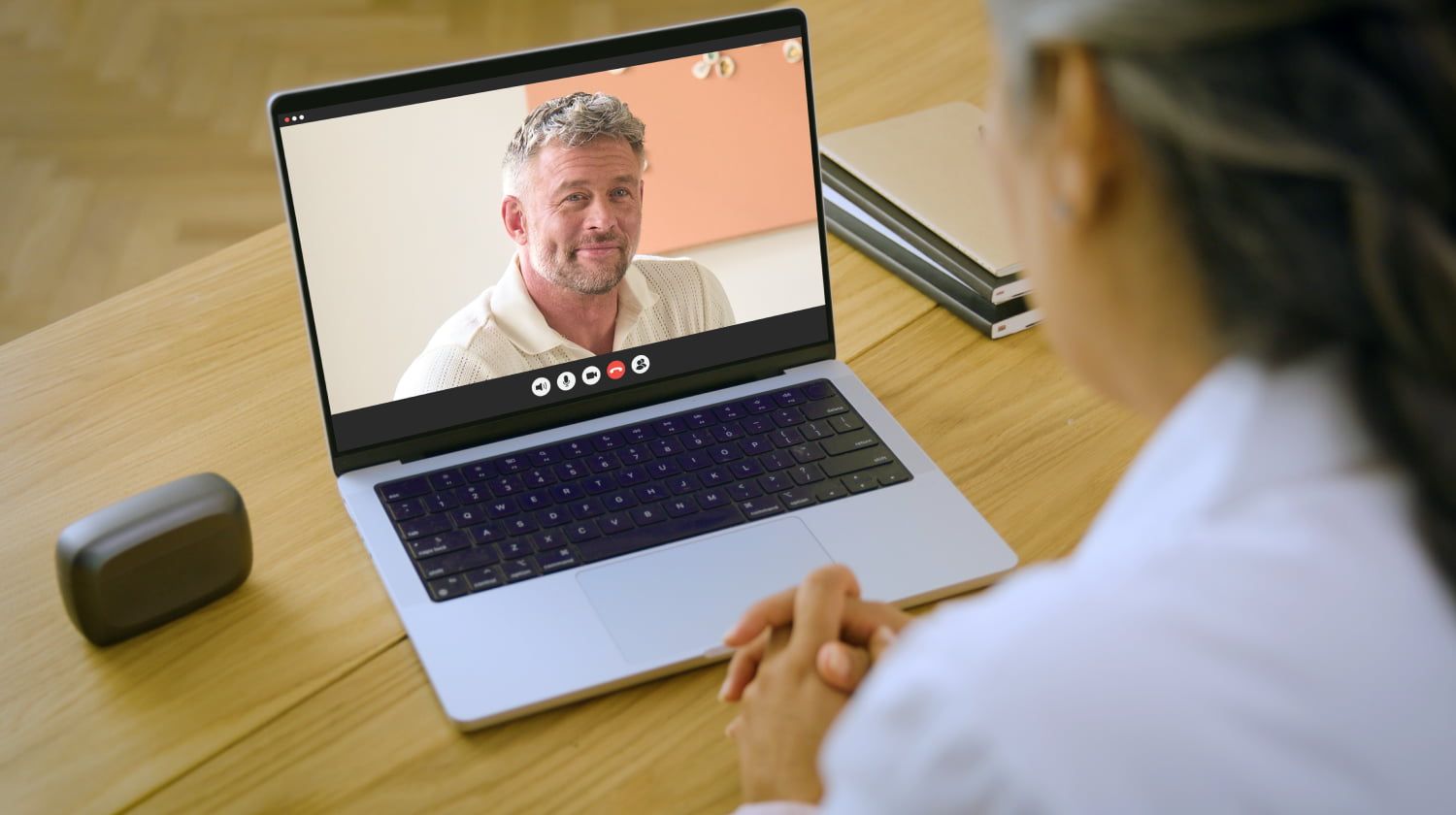
Jabra Enhance's licensed hearing professionals guide our customers through their journey using telehealth in order to make hearing as easy as possible.
3. Your budget
Budget is an inevitable part of your decision. At Jabra Enhance, we’re here to answer any questions you have.
Hearing aid models sold in clinics often range from $4,000 to over $8,000. Compared to clinics, Enhance Select hearing aids are less than half the price for similar quality. The price for Jabra Enhance Select hearing aids starts at $1,195 — for both ears. You can pay at once, or choose a convenient and flexible payment plan for as little as $39 per month*, depending on your plan.
Besides using your flexible spending account (FSA) or health savings account (HSA) when purchasing, or considering a payment plan, you may want to reach out to your insurance provider to check if you are eligible for hearing aid coverage.
*Minimum purchase of $50.00 is required. Availability of terms may vary based on purchase price, product, and state of residence. Down payment may be required. Subject to approval of credit application. Rates range from 0.00% to 34.99% APR, resulting in, for example, 36 monthly payments of $38.19 at 21.99% APR, per $1,000.00 borrowed. APRs will vary depending on credit qualifications, loan amount, and term. Bread Pay® loans are made by Comenity Capital Bank, a Bread Financial™ company.
See if you’re a candidate for hearing aids
How to buy hearing aids
OTC vs. prescription hearing aids
Compared to prescription hearing aids, OTC hearing aids can be a more accessible option for those with perceived mild to moderate hearing loss. OTC hearing aids are sold without a prescription to adults 18 years and older and can be sold online directly to consumers or in stores. Additionally, some OTC hearing aid companies also provide online audiology services for those who prefer to work with a licensed professional.
For example, Jabra Enhance offers personalized audiology services like initial fitting, check-ins, adjustments & fine tuning virtually — no office visit needed. This can be a more accessible and convenient option, especially for those who may live in rural areas, lack transportation, or have mobility issues that may make it difficult to travel to an office for appointments or adjustments — not to mention people who just want the convenience of receiving care in the comfort of their own home!
Finding affordable hearing aids in 2026
OTC hearing aids are an excellent choice for adults with perceived mild to moderate hearing loss seeking value. Many OTC hearing aids offer similar features, such as noise reduction, to prescription models, but at a lower price. Purchases can also include warranties and professional audiology services for added protection and personalization.
For example, when you buy directly from Jabra Enhance, you aren't just getting a hearing aid. Your purchase includes:
- 3 years of virtual audiology services from our Audiology Team who can:
- Review your hearing health history and work with you to establish your hearing goals
- Custom program your hearing aids to your personal hearing ability based on in-app self-tuning test results or your audiogram
- Make ongoing adjustments & fine-tunings to your hearing aids based on your feedback
- Educate on how to use and maintain your hearing aids
- Confirm the hearing aids are fitting properly
- Counsel on your specific hearing needs and expectations for your success with hearing aids
- 3-year loss & damage protection and warranty details
- Free lifetime customer service, technical support, and troubleshooting from our US-based Customer Support Team
- Mobile app to personalize your hearing aids and control your hearing aid settings
Are hearing aids covered by insurance/Medicaid/FSA?
Hearing aids are not always covered by insurance, so it’s important that you check with your insurance provider. Some insurance companies will cover a portion or percentage of the cost. Medicare does not cover the cost of hearing aids, however there are many Medicare Advantage plans that do cover them, either completely or partially. Also, many federal employees, in particular, may have plans that include hearing aid benefits.
Insurance may provide full or partial reimbursement for Jabra Enhance hearing aids if you have an ‘out-of-network’ hearing aid benefit which covers over-the-counter hearing aids and telehealth consultation. Here are some questions you should ask your insurance or benefits provider prior to contacting Jabra Enhance:
- Do I have a hearing aid benefit?
- Am I eligible for the benefit?
- What is my coverage amount per hearing aid?
- Does my coverage include OTC hearing aids?
- What codes do I need on a claim from a hearing aid vendor in order to provide me with my maximum reimbursement? (Note: Not all codes can be provided by telehealth providers, and some codes require that you obtain an audiogram meeting certain criteria prior to your hearing aid purchase.)
- Does my insurance cover telehealth services?
Questions? Call our team at (800) 854-2772.
Better hearing starts here
Check if you’re a candidate and get product recommendations for hearing aids.

Get started with Jabra Enhance
About Jabra Enhance
Jabra Enhance is on a mission to empower people with hearing loss to connect with their world through effortless technology and delightful care. We offer one of the most convenient and budget-friendly ways to purchase high-quality hearing aids.
Your first step can be to take our free online hearing test or upload an audiogram from an in-person professional to check for candidacy. The Jabra Enhance online hearing test takes approximately 3 minutes.
You may be a good candidate for Enhance Select hearing aids if your test suggests that you have mild to moderate hearing loss. If you determine that you are likely a good candidate, but you are unsure if you are ready to purchase from Jabra Enhance, you can easily contact us to discuss your options and concerns — give us a call at (800) 854-2772.
Get startedWhat Jabra Enhance customers are saying
We selected some reviews from enthusiastic customers to help you find your best fit. Read them here!
Reviews are from customers helped by our licensed Audiology Team within 30 days of purchase.
Ready to get started?
Take our online hearing test to see if Enhance Select hearing aids are right for you.