Hearing aid styles: Why RIEs are a popular choice
By Dr. Katie Keese, Au.D., Director of Audiology at Jabra Enhance
When people start exploring hearing aids, the most common thing I hear is:
“I just want the smallest one possible.”
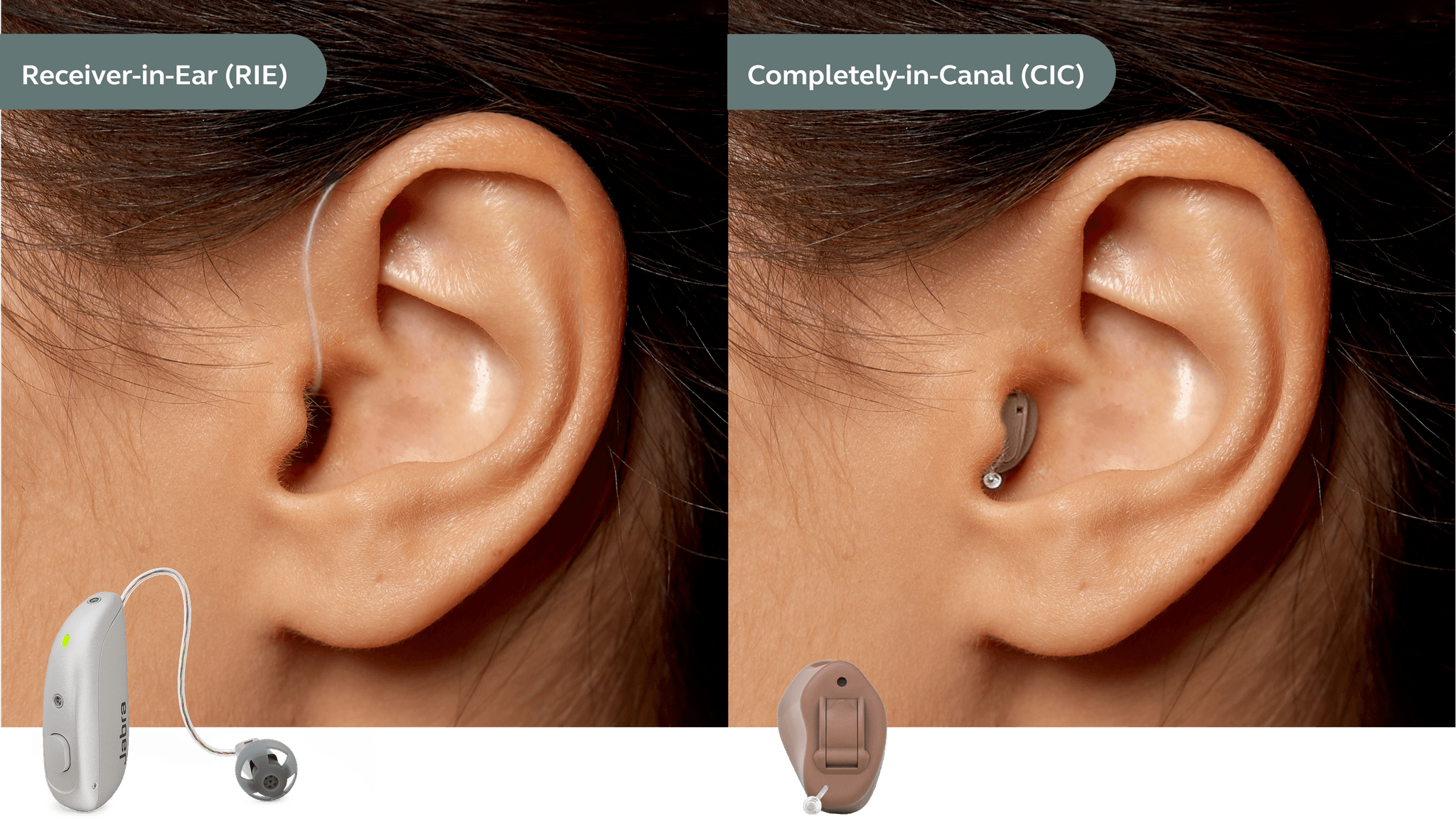
That instinct makes sense. For years, completely-in-canal (CIC) hearing aids were seen as the “invisible” gold standard — hidden deep in the ear canal. But technology has evolved, and so have customer priorities.
Today, receiver-in-ear (RIE), also known as receiver-in-canal (RIC), hearing aids are smaller, smarter, and more comfortable than ever before.
While CICs still win on invisibility, RIEs offer a more complete hearing experience — one that balances a discreet look with advanced performance. And that’s why Jabra Enhance focuses exclusively on RIE technology: it delivers the features and benefits most people care about once they start wearing hearing aids every day.
Take a free online hearing test
Are RIE hearing aids right for you? Check in just 3 minutes.
Why people love completely-in-canal hearing aids. And where they fall short
CIC hearing aids have one undeniable advantage: they’re incredibly discreet. The entire device sits inside the ear canal, and from the outside, it’s very hard to see.
That makes them appealing for anyone nervous about how hearing aids look. But the trade-off for that small size is limited space. And often, that means limited features. CICs often:
- Have smaller disposable (or sometimes rechargeable) batteries that may drain more quickly than RIEs
- Offer fewer models with advanced technology such as Bluetooth
- Require more frequent maintenance, since they sit close to earwax and moisture
Many CICs also tend to block the ear canal completely, which means that, depending on the level of your hearing loss, you’re more likely to notice that your own voice sounds echoey or hollow, something known as the occlusion effect.
For people with mild to moderate hearing loss who want invisibility above all else, a CIC may be the right choice. But for most wearers, the benefits of a modern RIE outweigh the trade-offs.
Why RIE hearing aids have become the go-to choice
Discreet design, modern look
Today’s RIE hearing aids are surprisingly small. The slim, lightweight piece that sits behind the ear connects to a tiny receiver in the ear canal with a nearly invisible wire. From most angles, it’s barely noticeable — especially if you choose a color that matches your hair or eyeglass frames.
This balance between discretion and functionality is part of what makes RIEs so popular.
Comfortable, open, and natural
RIEs often use an open-fit dome, which allows natural sound to mix with amplified sound. Research shows open fittings reduce the occlusion effect, improve comfort, and make speech sound more natural.
For many wearers, that translates to lighter, all-day comfort — the kind that makes hearing aids easier to wear consistently.
Longer battery life and rechargeable convenience
Because RIEs have slightly more space behind the ear, many house larger batteries or rechargeable systems that last a full day (24 hours) or longer.
CICs, by contrast, often use tiny disposable batteries that often need to be changed every few days, or rechargeables that can’t last a full day — a small frustration that can become a big barrier to regular use, especially for people with dexterity or vision challenges.
Technology for modern life
RIE hearing aids are designed to integrate seamlessly with the way we communicate and connect today. Most RIE models offer advanced technology such as:
- Bluetooth streaming for calls, TV, and music.
- Smartphone apps for volume and program control.
- Directional microphones that help in noisy environments.
- Remote adjustments, no in-person visit required.
CICs typically don’t have the internal space to support all these kinds of technology features.
When a CIC still wins
There’s still a place for CIC hearing aids. If you have mild hearing loss and absolute invisibility is your top priority, CICs can deliver that. And while modern signal processing algorithms have reduced wind noise in RICs, CIC’s typically perform well in windy conditions since the microphone is shielded inside the ear canal.
But most people find that once they experience the comfort, sound quality, and convenience of a RIE, those small differences no longer matter.
Why RIEs are a popular choice. And the only style we offer
The shift toward RIE hearing aids isn’t just about new technology, it’s about results. RIEs balance performance, comfort, and discretion in a way that helps people wear their hearing aids longer and hear more naturally.
That’s why RIEs have become such a popular hearing aid style. And it’s why Jabra Enhance exclusively offers RIE hearing aids: they give customers the best combination of comfort, connectivity, durability, and clarity — all in a design that’s discreet enough to disappear behind your ear.
No matter which style you choose, take that next step to addressing your hearing loss and reconnect with your world again.
Compare RIE hearing aids
Clear, comfortable, durable — all in a discreet hearing aid.